Case Study · 02 · 2026

Stache
Studios.

An artist's storefront, built on
the right tool. Not the most ambitious one.

Client
Mark, aka Stache · Illustrator
Location
Malta
Scope
Shopify build · Conversion · CRM
Platform
Shopify, customised end to end
The Stache Studios homepage at stachestudios.com. A bold WELCOME headline introduces the storefront, with a nav bar across the top covering Home, Full Catalog, Top Sellers, Stache Picks, Bundles, T-Shirts and Apparel, Stache Studios, and Commissioned Work. A featured artwork sits on the right side of the hero.
FIG. 00 · The Stache Studios storefront at stachestudios.com Built by Blinklabs · 2026
At a glance · Outcomes
AZ.
End-to-end
solution delivered
1.
Link to share
That's the whole brief
100%.
Self-managed
after handover
MT.
Maltese
to the bone
01 The client

Teacher, parent,
illustrator.


Mark is a teacher. A parent. And, at every spare moment in between, the illustrator behind Stache Studios.

His prints take iconic Maltese landmarks and slang phrases ("Kemm int tal-Ostja", "Iddejjaqlix Għajni", "Teqridx") and pull them through a surreal, alternative lens. Traditional soul, alternative spirit. The kind of art that belongs on a wall and gets a smile of recognition from anyone who grew up here.

For years, Mark sold the way most working artists sell. Pop-up markets on weekends. Instagram DMs at midnight. Hand-to-hand at events. It worked, but it didn't scale, and it didn't free up the one thing he needed most: time to make more art.

Why "Stache"

Mark has a moustache. That's the whole story. Stache Studios wasn't born in a branding meeting; it started as a signature at the end of a print and grew into a name people recognise. Maltese culture meets humour, attitude, and an alternative edge.

02 The problem

He'd tried to fix it
once already.


Before us, Mark spent weeks in meetings with a freelancer who wanted to build him a fully custom website, a custom backend, and a custom CDN.

By the end of the debrief, Mark had a stack of jargon, a scope that kept getting bigger, and no website. He walked away.

The brief Mark really wanted was simple. "I want a link I can share. I want to tell people I'm live."

He didn't want to learn about content delivery networks. He didn't want a database admin panel. He didn't want to be the one debugging deploys on a Sunday night. He wanted to make art, and he wanted a storefront to sell it from. Built once. Handed over. Run by him.

The mistake the previous freelancer made was building for the agency, not the artist.

He wanted a link he could share. Not a database admin panel.

The brief, restated
Interlude · FIG. INT

Prodott
Malti.

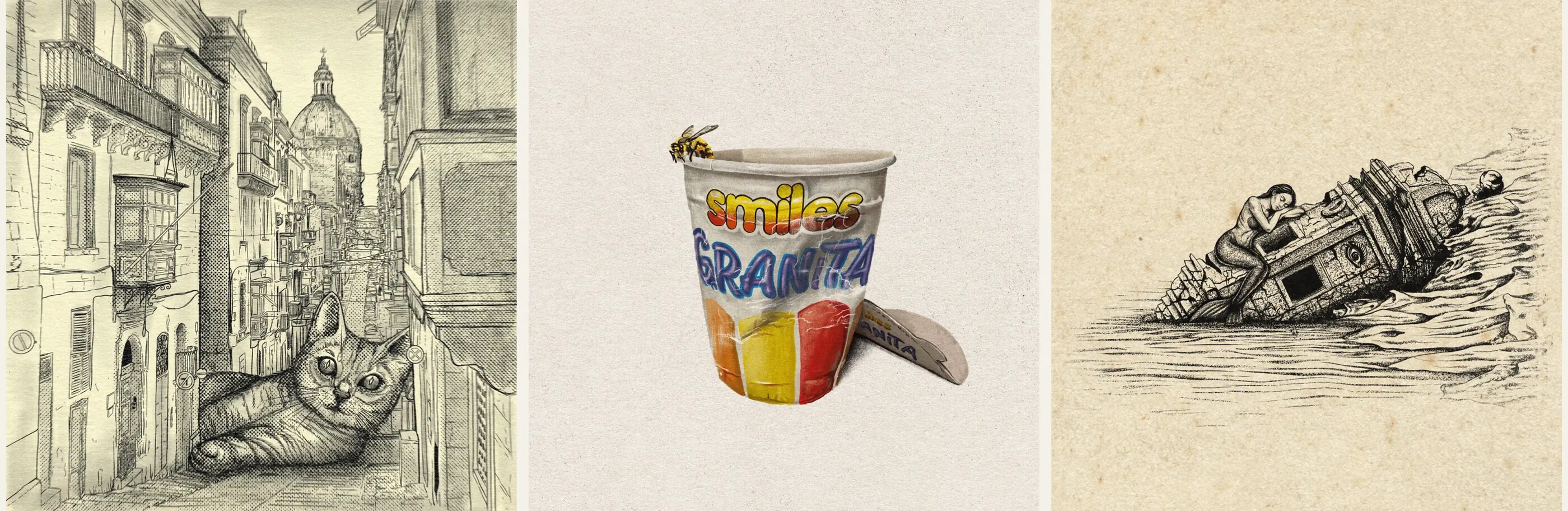
Stache's work is unmistakably Maltese. Cisk Excel, Kunserva, Filfla, the cats of Valletta, the slang you grew up hearing. Every print is a wink at someone from this island.

The site we built had to feel as Maltese as the art on it. No generic templates. No stock photography. Every section, every word, every animation tuned to Mark's voice.

Build for the artist. Not for the platform.

Three Stache Studios prints. A sleeping Maltese cat in a Valletta street with the limestone architecture behind it, a Maltese kazin granita cup mid-melt with a wafer, and an abandoned Maltese mermaid washed up amid wreckage.
FIG. INT · PRODOTT MALTI Three of Mark's prints. Cats, granita, mermaids. Maltese culture through an alternative lens.
03 The approach

We met him where
he was.


Not where the brief wanted to take him.

The right tool was obvious as soon as we listened. Shopify. Not because it was the cheapest, easiest, or most fashionable, but because it solved the actual problem.

Mark needed to add products without a developer. He needed sales he could launch on his own. He needed an admin he could open on his phone in five minutes between classes. He needed payments, shipping, taxes, and inventory handled out of the box. He needed something that would still work the day we walked away.

A custom build would have given him none of that. A Shopify build, done right, would give him all of it.

The "done right" is where the work was. Shopify is a platform, not a finished store. We bought a clean theme as a foundation and then rebuilt almost everything on top of it: structure, copy, custom sections, button animations, product page logic, checkout flow, payment routing, CRM workflows, email automation, customer segmentation, and a recommendation engine trained on Mark's actual catalogue.

The customer sees a beautiful storefront. They never see the Shopify.

A note on platform choice

Shopify gets dismissed as "just a template platform" by people who haven't actually built on it. The truth: it's a platform with a complete, intuitive backend that scales from one artist to a million-product retailer. The theme is the foundation. Everything on top is where the work lives.

04 What we built

A Shopify store
that doesn't
look like one.


Four interlocking layers. The brand-led storefront on top. The product experience underneath. The commerce mechanics behind that. The CRM doing the quiet work in the background.

FIG. 01 · Brand-led storefront

Built for Mark.
Not for Shopify.

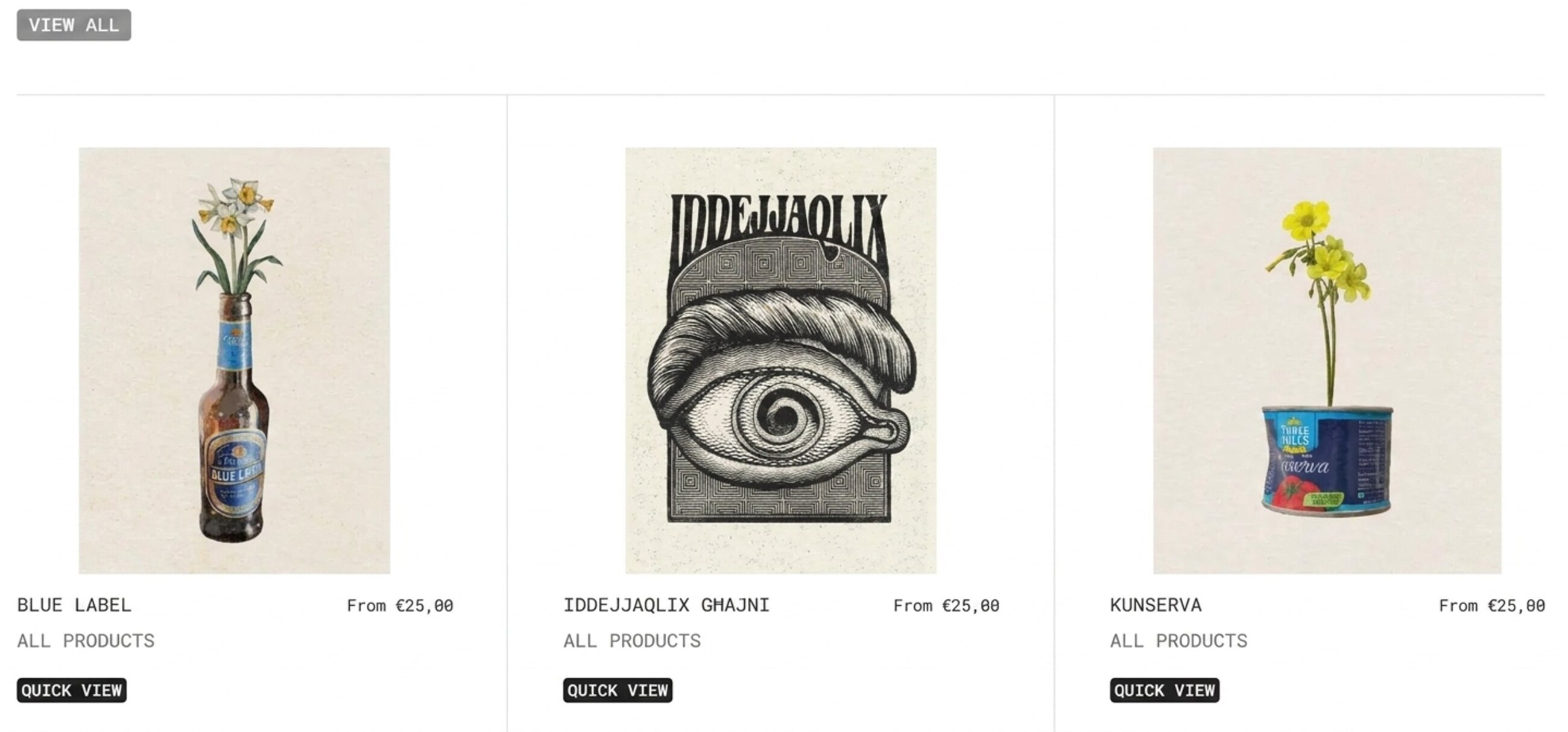
Custom marquee bands, custom sections, custom button animations, custom copy. The theme is the studs in the wall. Nothing else is off-the-shelf. The homepage opens with one of Mark's loudest pieces, "Kemm int tal-Ostja", and a hero line written to feel like he's talking to you.

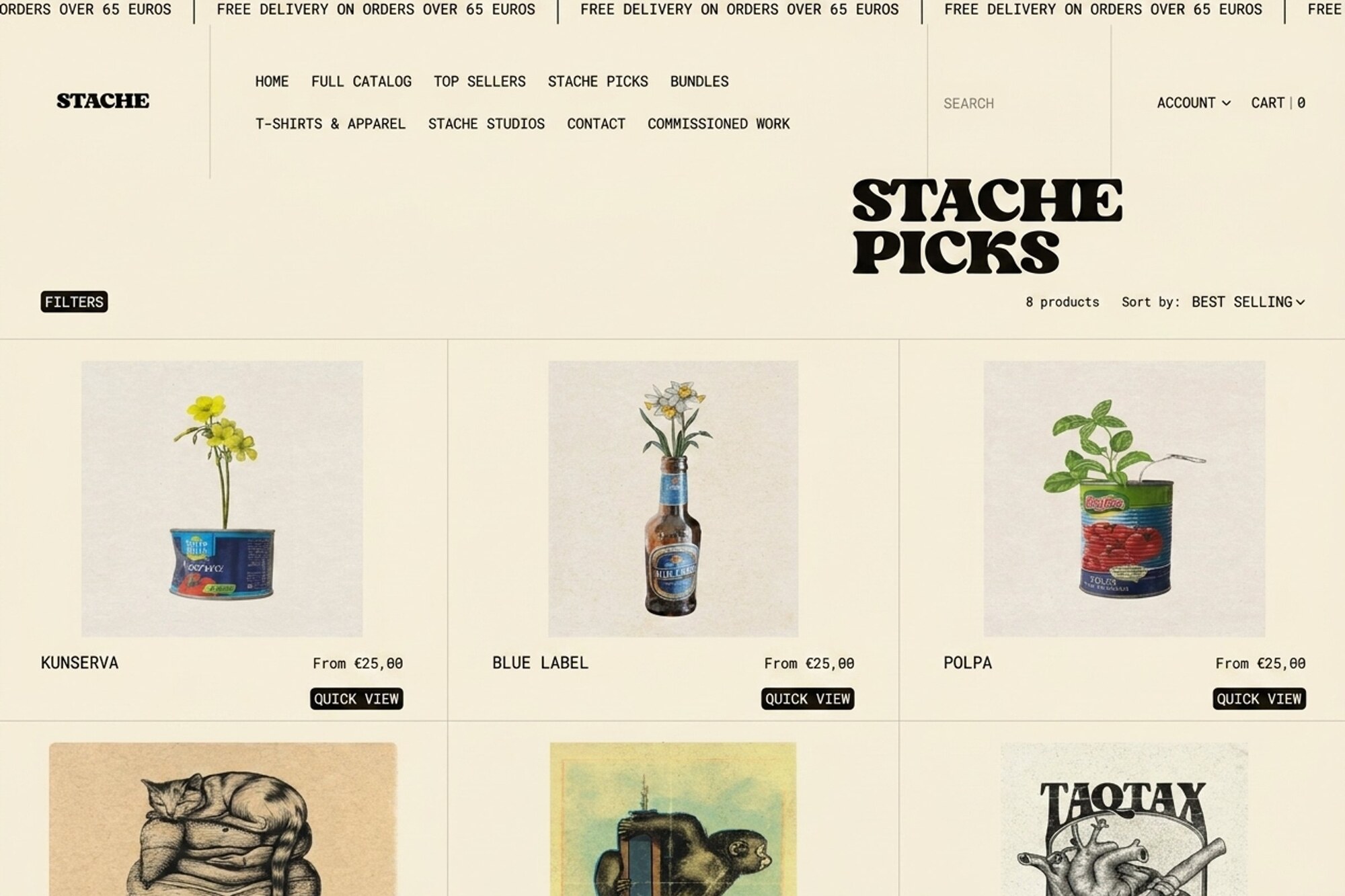
A merchandising row on the Stache Studios homepage. Three product cards stand in a row: Blue Label on the left, Iddejjaqlix Ghajni in the middle, Kunserva on the right. Each has a print thumbnail, the price, an ALL PRODUCTS tag, and a Quick View button. A VIEW ALL link sits above the row.
01.A · HOMEPAGE The "Stache Picks" merchandising row on the homepage. Custom cards, custom hover, quick-view inline.
The opening of the Stache Studios about page on mobile. A headline reads I AM MARK AND THIS IS MY STORY, with a tagline yes, my name is not stache beneath it. Below the headline, a portrait of Mark himself, smiling, arms crossed, wearing one of his own printed t-shirts.
01.B · ABOUT PAGE Mark's story, chaptered editorially. The spark, the niche, the journey, the studio. In his voice, not ours.
FIG. 02 · The product experience

Mobile-first,
three taps to buy.

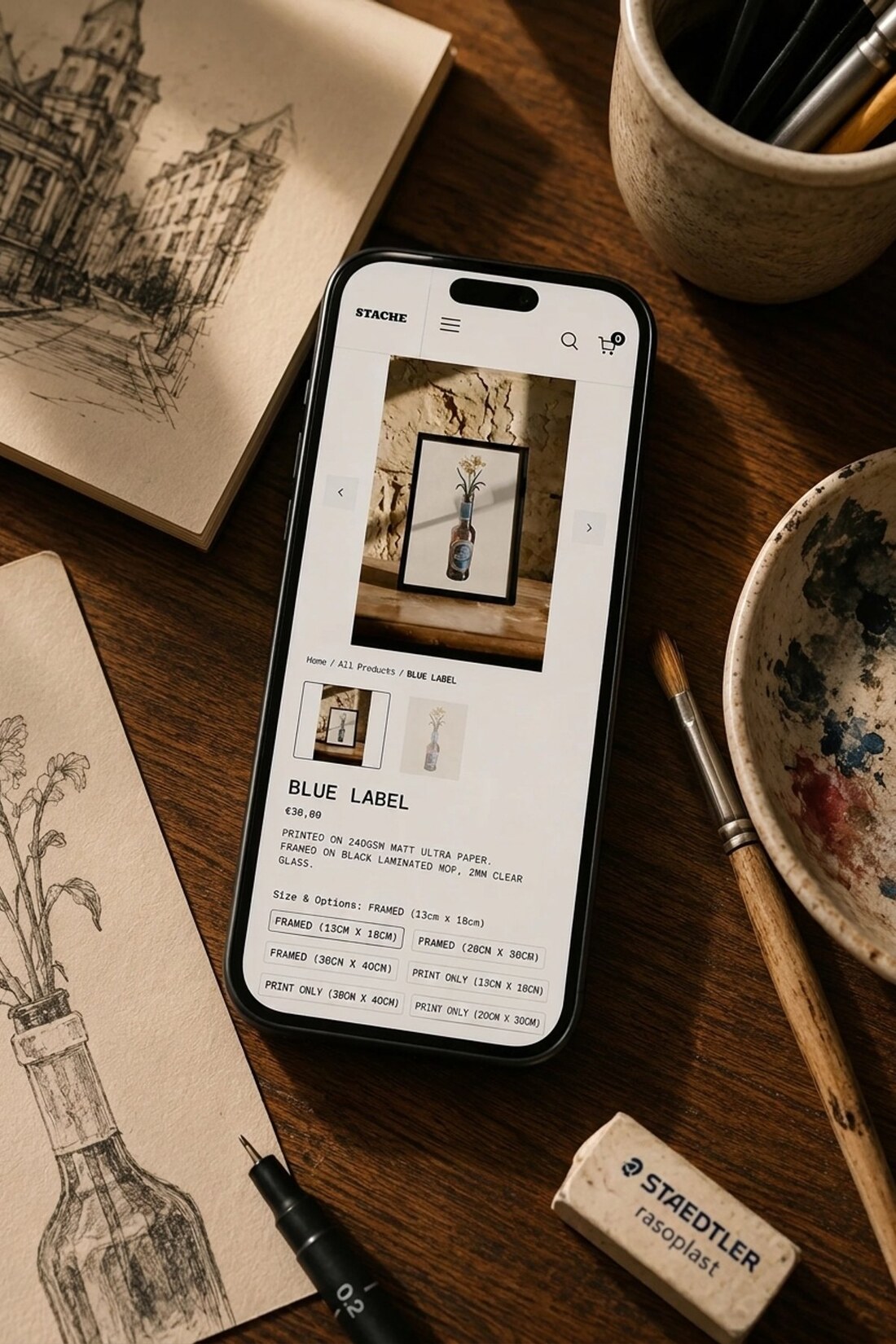
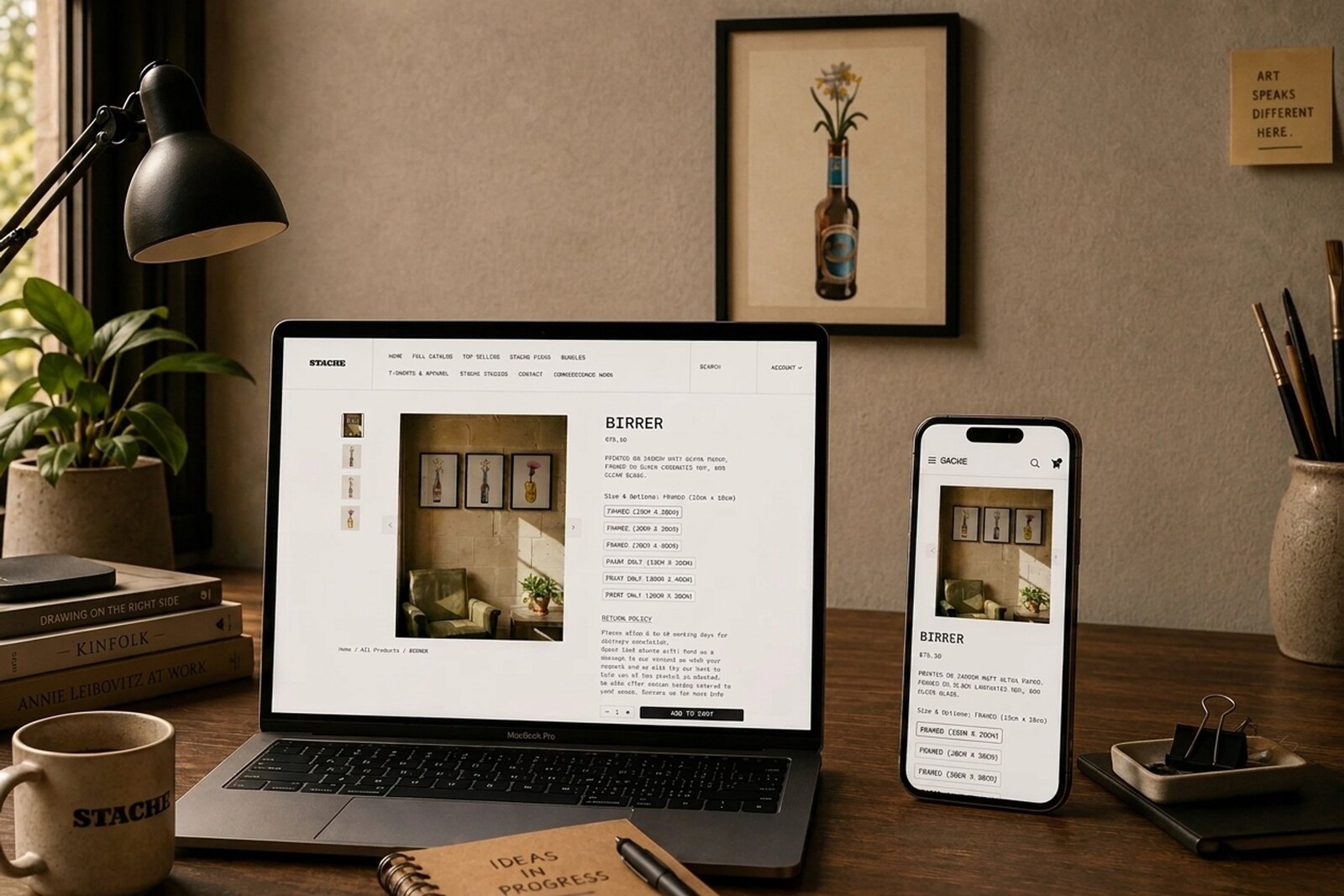
Designed for the customer who buys art on their phone, on the bus, in three taps. Mobile-first throughout. Hover-swap on collection cards previews the framed piece without opening the product page. Variant pickers handle size and frame format inline. Quick view keeps customers browsing.

FIG. 03 · Bundles & recommendations

Three prints,
one wall.

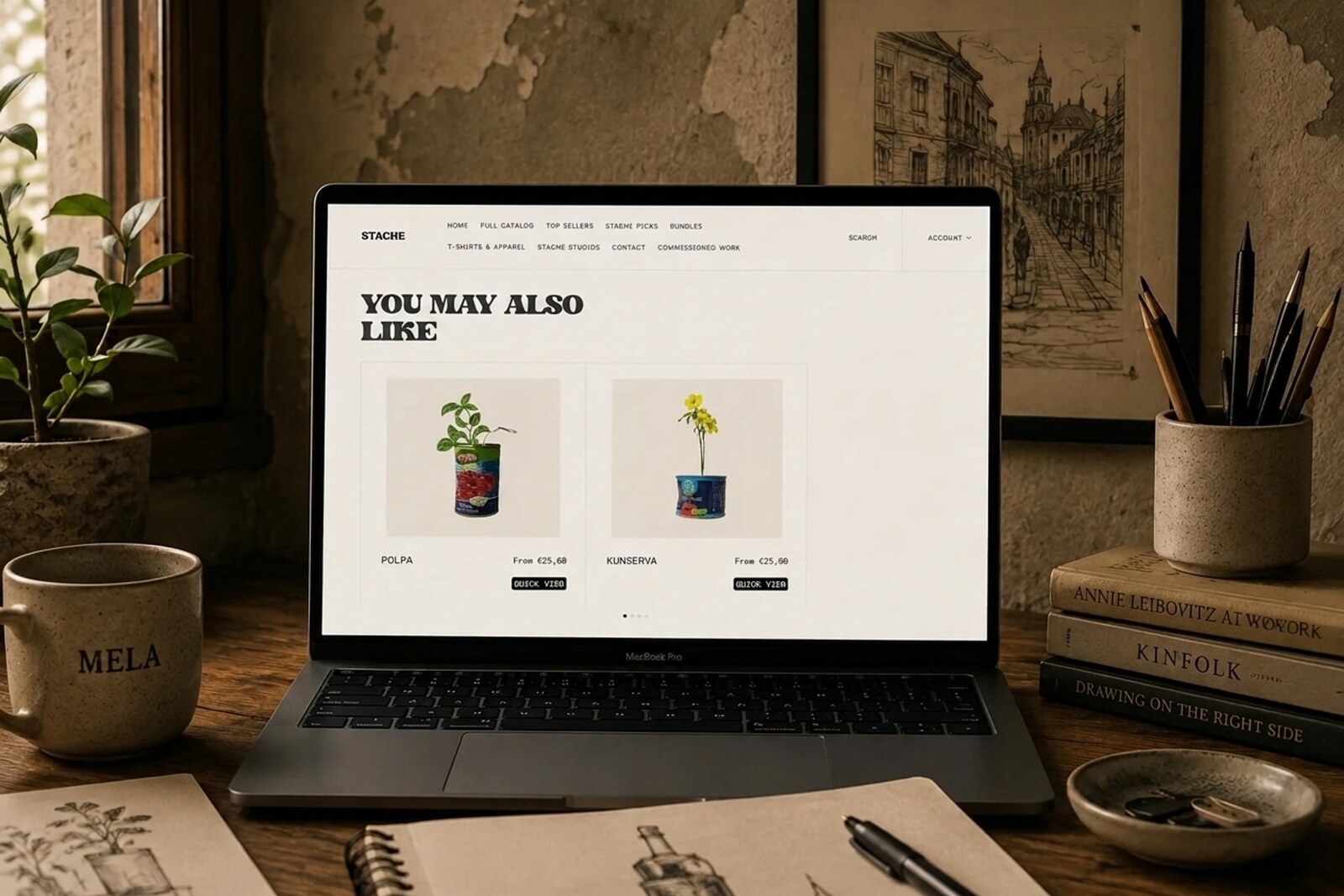
Bundles let Mark merchandise sets at an ideal price. A wall of three prints rather than one. The "you may also like" panel is a custom recommendations engine, trained on Mark's catalogue with a small Python pipeline so it actually understands which prints sit well next to which.

The Birrer bundle product page. Three framed beer-themed prints hanging in a row on a Maltese limestone wall above a sofa and a houseplant, photographed as a living-room mock-up. Price 76 euros 50, a return policy block, a Size and Options variant picker with framed and print-only formats at three sizes each, and an Add to Cart button.
03.A · BUNDLES A wall of three at an ideal price. Cross-sell that feels like a recommendation, not a popup.
The You May Also Like panel at the bottom of a Stache Studios product page. Two recommended prints sit side by side: Polpa from 25 euros and Kunserva from 25 euros, each with a Quick View button. A four-dot carousel indicator sits beneath, hinting that more pairs slide into view.
03.B · RECOMMENDATIONS Custom logic trained on Mark's catalogue. Pairs that make sense, not Shopify's default guesses.
FIG. 04 · The CRM

The quiet work,
done in the
background.

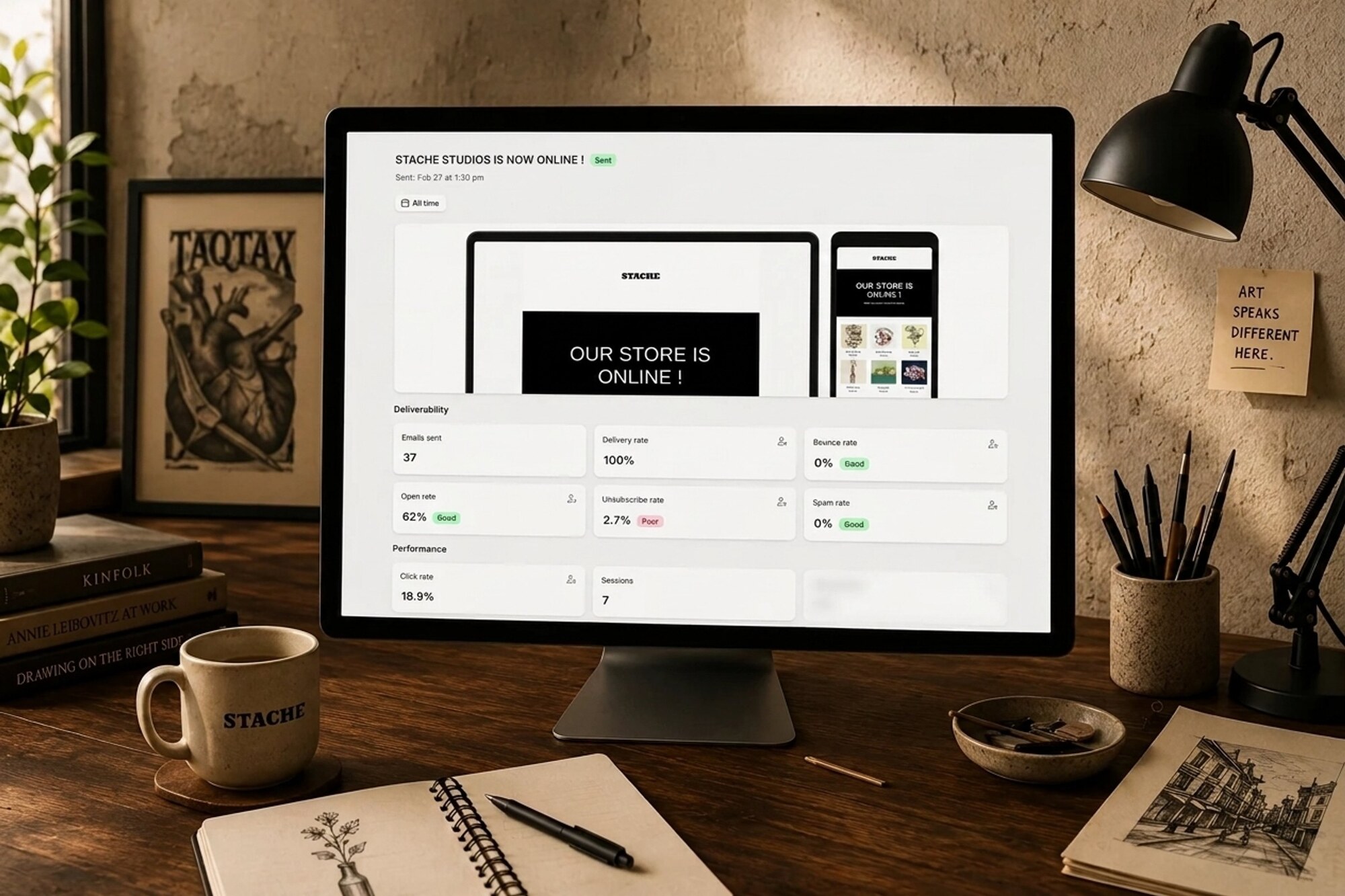
Every visitor who joins the list earns 10% off and lands in an automated flow that introduces Mark, the work, and the next collection drop. Customers get segmented automatically based on what they buy, where they shop from, and how often they come back. Mark sends one campaign and it lands tailored, not generic.

The performance dashboard for the launch email STACHE STUDIOS IS NOW ONLINE. Desktop and mobile previews show the OUR STORE IS ONLINE message and the product grid. Deliverability tiles read: 37 emails sent, 100 percent delivery, 0 percent bounce, 62 percent open rate marked Good, 2.7 percent unsubscribe marked Poor, 0 percent spam marked Good. Click rate 18.9 percent, 7 sessions, with the conversion-rate tile blurred for confidentiality.
04 · CRM The launch email. 62 percent open rate, 18.9 percent click rate, on a list Mark grew himself.
05 The handover

We handed him
a business.


Not a website. A business he could run.

Mark adds products himself now. He launches sales himself. He runs his own promotions for holidays, summer pop-ups, new collection drops. He posts a new piece, lists it in the admin between classes, and it's live before lunch.

We're a call away if he wants new features or a new collection page, but the day-to-day belongs to him.

That was the brief from day one. The work isn't done until that's true.

"Ħa ngħidlek, għandek
ħafna paċenzja għal
dawn l-affarijiet."

"Let me tell you, you've got a lot of patience for this kind of thing."

Mark  ·  aka Stache, Stache Studios
06 What changed

The art got more
time.


And the artist got his evenings back.

Mark stopped selling out of his DMs. Orders ship from a storefront, not an inbox. Bundles let him merchandise the work in ways a single Instagram post never could. The 10% welcome flow has built him an email list of customers who hear about new drops before anyone else.

The work that used to live in WhatsApp threads now lives in a system. Mark stopped being his own logistics team.

The store opened a real revenue stream. The handover gave Mark his time back. Both were the point.

07 Where we are now

Still around.


Mark runs the store. We pick up when he wants something new.

A new collection page when a fresh batch of prints drops. A campaign template when a holiday comes around. A tweak when something on the site could work harder.

The website is finished. The relationship isn't.

Have an idea
that needs a real
storefront?

We'll help you pick the right tool. Even if it's not the most ambitious one.

Tell us about your idea